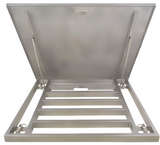
Marine Platform Scale

M5 Series Marine Platform Scale

The M5 Series is a heavy-duty flip-up platform scale with four load cells in AISI 316 stainless steel. It is designed for vessels where deck space is limited and heavy loads must be weighed in rough conditions.

Read the full description
Capacity
600–3000 kg
Readability
200–5000 g
Build
AISI 316 · 4 load cells
Models
9
Marine scales overview 2026 (brochure)PDF

Enter your name and email address and we will email you the download link.

Ask a question about this productQuote-based pricing · configured to your vessel

Models

Every model has its own article number. Add the models you need to your quote request – no prices, no obligation.

Article no.ModelCapacity ReadabilityPlatformAdd to quote request
WPL-M5S-1000x1000-600KG M5-S 600 kg 200–500 g 1000×1000 mm
WPL-M5S-1000x1000-1500KG M5-S 1500 kg 500–1000 g 1000×1000 mm
WPL-M5S-1000x1000-3000KG M5-S 3000 kg 1000–5000 g 1000×1000 mm
WPL-M5M-1200x1200-600KG M5-M 600 kg 200–500 g 1200×1200 mm
WPL-M5M-1200x1200-1500KG M5-M 1500 kg 500–1000 g 1200×1200 mm
WPL-M5M-1200x1200-3000KG M5-M 3000 kg 1000–5000 g 1200×1200 mm
WPL-M5L-1500x1500-600KG M5-L 600 kg 200–500 g 1500×1500 mm
WPL-M5L-1500x1500-1500KG M5-L 1500 kg 500–1000 g 1500×1500 mm
WPL-M5L-1500x1500-3000KG M5-L 3000 kg 1000–5000 g 1500×1500 mm

Options change the article number. Mention it in a question or quote request so we know exactly which model you mean. View quote request →

Description

The M5 Series is a heavy-duty marine platform scale for weighing loads from a few hundred kilograms up to 3000 kg where deck space is limited. It is the successor to the WPL M4 and is available with three platform sizes, three capacities and a range of communication options.

A flip-up platform for tight decks

The M5 platform can be raised when it is not in use. That gives two practical benefits: the area underneath can be cleaned properly, and the deck space is available for other work. On vessels where every square metre is shared between catch handling, gear and crew movement, a platform that folds out of the way can be the difference between having a floor scale and not having one.

Compensation for motion, tilt and gravity

The M5 corrects automatically for vessel motion, tilt of the deck and changes in gravity. Each effect alters the force on the load cells in its own way: vertical acceleration adds to or subtracts from gravity, tilt reduces the force measured by the cells, and gravity itself varies with latitude. How motion compensation works explains what compensation achieves, gravity, latitude and calibration explains why a scale calibrated in one port reads differently far to the north or south, and weighing accuracy in rough seas covers what to expect in heavy weather.

Four load cells in AISI 316

The platform rests on four load cells, a construction that gives stable and repeatable results wherever the load is placed. The scale is made of AISI 316 stainless steel with smooth, hygienic surfaces for quick washdown, and it is engineered to withstand daily cleaning and harsh marine conditions. EU hygiene rules require equipment on board to be corrosion-resistant and easy to clean and disinfect (Regulation (EC) No 853/2004, Annex III, Section VIII); see the hygiene and materials hub.

Connectivity and options

A wall mount for the indicator is included. Options include RS232, Ethernet and WiFi communication, USB, Bluetooth LE, a battery, remote displays, relay boards, digital I/O signals, label printers and report programs. The WeightControl IOT module logs every weighing automatically; the EU weighing rules require non-automatic scales used to weigh pallets of fishery products to keep at least an automatic or semi-automatic log (Implementing Regulation (EU) 2026/1932, Annex I, Part B, point 5). Approval for such use is a matter for national authorities; see the legal metrology hub. For data handling, read weighing data logging.

Typical applications

Calibration certificate

Every M5 scale can be supplied with an EURAMET cg-18 calibration certificate as an option. The certificate records the repeatability, eccentricity, errors of indication and measurement uncertainty of the scale, which quality systems and audits often ask for. Calibration is not the same as legal verification; EURAMET cg-18 calibration explained sets out the difference.

Choosing the right configuration

All three capacities (600, 1500 and 3000 kg) are available on all three platforms (1000×1000, 1200×1200 and 1500×1500 mm), and higher capacities are available on request. Size the platform to the footprint of your largest container or pallet, and the capacity to the heaviest gross load including tare. The platform size guide, capacity and readability explained and installing marine scales help with the choice. Compare with the M6 Series, then request a quote.

Features

  • Flip-up platform for cleaning underneath and saving deck space
  • Compensates for vessel motion, tilt and gravity changes
  • Four load cells for stable, repeatable results
  • Platforms 1000×1000, 1200×1200 and 1500×1500 mm
  • 600, 1500 and 3000 kg; higher capacities on request
  • AISI 316 stainless steel with smooth, hygienic surfaces
  • RS232, Ethernet and Wi-Fi communication
  • Remote displays, relay boards and digital I/O
  • Label printers and report programs
  • Wall mount included; WeightControl IOT, Bluetooth LE and battery optional
  • Optional EURAMET cg-18 calibration certificate

General

ManufacturerWPL Industries
SeriesM5 (successor to the M4)
TypeFlip-up marine platform scale
ModelsM5-S · M5-M · M5-L
Used inDecks with limited space, heavy loads
DeliveryWorldwide, 50+ countries

Technical specifications

TypeFlip-up marine platform scale
Capacities600, 1500 and 3000 kg; higher capacity on request
Readability200–500 g (600 kg) · 500–1000 g (1500 kg) · 1000–5000 g (3000 kg)
PlatformsM5-S 1000×1000 · M5-M 1200×1200 · M5-L 1500×1500 mm
Capacity per platformAll capacities available on all three platforms
Load cells4
MaterialAISI 316 stainless steel
CompensationVessel motion, tilt and gravity changes
DesignFlip-up platform; hygienic smooth surfaces for washdown
MountingWall mount included
Communication optionsRS232, Ethernet, WiFi, USB, Bluetooth LE
Other optionsWeightControl IOT module, battery, remote displays, relay boards, digital I/O, label printers, report programs, EURAMET cg-18 calibration certificate
PredecessorM4
FAQ

M5 Series Marine Platform Scale – frequently asked questions

What is the difference between the M5 and the M6?

Both use four load cells, AISI 316 stainless steel and the same platform sizes and capacities. The M5 has a flip-up platform for cleaning and saving deck space, and compensates for motion, tilt and gravity changes. The M6 is the economic variant with a fully sealed construction, motion and tilt compensation and an optional access ramp.

Can the M5 weigh more than 3000 kg?

The standard capacities are 600, 1500 and 3000 kg on 1000×1000, 1200×1200 and 1500×1500 mm platforms. Higher capacities are available on request. Tell WPL your heaviest gross load, the footprint of your containers and where the scale will be installed, and the options will be assessed for your vessel.

Why does a platform scale need gravity compensation at sea?

Gravity is weaker at the equator than near the poles, by roughly half a percent. A scale calibrated in one port therefore reads differently when a vessel fishes at a very different latitude. On a 3000 kg load that difference is significant, which is why the M5 corrects for gravity changes as well as for motion and tilt.

Can the M5 be connected to a label printer or remote display?

Yes. Label printers, remote displays, relay boards, digital I/O signals and report programs are available as options, together with RS232, Ethernet, WiFi, USB and Bluetooth LE communication. The WeightControl IOT module adds automatic logging of every weighing, CSV export and a JSON API.

Is the M5 the replacement for the M4?

Yes. The M5 Series is the successor to the WPL M4 marine motion-compensated floor scale. If you operate an M4 and plan a replacement, include the M4 details and the current installation location in your quote request so the new platform and mounting can be matched to the space.

Does WPL have a dealer in my country?

WPL works with more than 20 dealers in different countries. Fill in the contact form with your location, and we will put you in touch with the dealer for your region or help you directly.

Knowledge centre

Learn more before you choose

Weighing at sea

Motion Compensation in Marine Scales: What It Does and How to Judge It

Motion compensation lets a marine scale show the true weight of a load while the deck heaves, pitches and rolls. Good compensation gives a steady reading, fast settling, and correct...

Read guide
Weighing at sea

Gravity, Latitude and Why Marine Scales Need Gravity Compensation

Gravity increases by about 0.53% from the equator (9.780 m/s²) to the poles (9.832 m/s²). A scale adjusted at 52° N reads about 0.14% heavy at 70° N: 21 g...

Read guide
Legal metrology

EURAMET cg-18 Calibration of Weighing Instruments Explained

EURAMET cg-18 is the European guideline for calibrating non-automatic weighing instruments. A cg-18 calibration tests repeatability, errors of indication across the range and eccentricity, and reports each error with its...

Read guide
Buying guides

Choosing the Platform Size for Fish Boxes, Baskets and Samples

Choose a platform that fully supports the base of your largest regular container, with nothing else touching it. Typical European fish boxes measure 600 × 400 mm (10–15 kg fillet...

Read guide
Buying guides

Installing a Marine Scale on Deck or in the Fish Hold

Install a marine scale close to amidships and the centreline, on a rigid wall or column mount fixed to structure, levelled at normal trim. Keep hoses and cables off the...

Read guide
Weighing at sea

Getting Accurate Weights in Rough Seas: A Practical Checklist

Accurate weighing in rough seas starts with location: mount the scale close to amidships and the centreline, rigidly and level. Then match filter and stability settings to the job, zero...

Read guide
Talk to an engineer

Tell us what you weigh and where

Every vessel is different. Share your application and we will recommend a scale, platform size and options – with a no-obligation quote.